Nonfiction. 288 pgs. Pantheon Books. June 2025. 9780593317624.
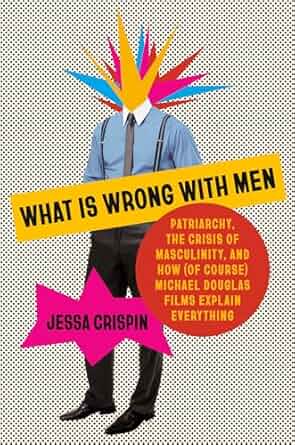
Something is wrong with men. They are stockpiling weapons and exploding Cybertrucks in front of weird hotels. They are drinking on the job, and their job is to oversee the largest military in the world. It wasn’t many Christmases ago that one jolly stud blew himself up in an RV in the middle of downtown Nashville.
Women also do things that are hard to understand, but those rarely end with literal explosions. And while there are some notable women cranks at the top of the world, the men have gone farther off the deep end than anyone, and they are running the country. They want to turn schools into churches. They want to turn libraries into churches.
Men are making things worse at this grand scale and at the ground level, too. As Jessa Crispin puts it in her new book, What Is Wrong with Men:
[W]hat is it that is keeping us from living lives free of violence and oppression? Well, men. It’s men who are raping women, men bombing abortion clinics and assassinating our doctors, men harassing women on the street, men not giving us jobs or promotions, men telling sexist jokes at the party, men not taking our claims of domestic violence or sexual violation by other men seriously when we seek help and intervention… The political awakening of the third wave was one big muddle of the horrific and the mundane, the structural and the interpersonal, but there was one common factor: standing between the promise of liberation and the reality of oppression was men.Men are not like this, Crispin explains, because they lead happy, fulfilled, balanced lives, and this is what they must do, or feel they must do, to sustain their primacy. Men are deeply in crisis. They are “failing to thrive. They are more likely than women to fall into addiction, suicide, and despair… And every day there they are, on the news, in our offices, in our faces, making a spectacle of themselves.” The old model of patriarchy, that former way of doing things, in which a man was secure in his position as father, husband, and provider, has eluded today’s men. It has given way to “something worse,” and not only have men lost their power, they have failed to reckon with their changed status.
Many refuse or fail to acknowledge a change has taken place. They take their diminished role in the world as a sign of personal failings, the solution to which is to do things like swallow mouthfuls of raw beef and pill supplements.
Today, in a much more atomized and disconnected society, masculinity is something more individualistic. It’s about fulfilling certain metrics, like numbers in your bank account, your muscle to fat ratio, or number of sexual partners. Pure masculinity is always glittering out there somewhere on the horizon, never fully achievable but something to be pursued at all costs.
We have work to do, therefore, in the way of studying men, and figuring out what made them like this, so we can talk them down from the ledge that so many of them can’t wait to leap from. Crispin takes up this labor by giving us a long, close look at films across the eighties and nineties that star Michael Douglas.
She builds a case that, of all the actors who have played starring roles in films in recent decades, it is Michael Douglas who can help us retrace our steps and determine how men got to where they are. By tracking Douglas’s cinematic career, we can better understand the men of this nation. “For if there’s something wrong with Michael Douglas, the movie star and the symbol at the time of new masculinity, perhaps we can learn if there might not be something wrong with all of us?”
Michael Douglas may seem at first to be an unlikely choice for this. Who, after all, are the men who represented manhood in prior eras, who established a masculine ethos through their bodies of work? John Wayne comes to mind, as do Gary Cooper and Humphrey Bogart. There is Steve McQueen; there is Paul Newman. Michael Douglas is hardly their likely inheritor.
That, of course is the point:
After all, what did Michael Douglas present to the world in his string of blockbuster films through the eighties and early nineties but a performance of being extremely unwell? His was a performance of injury, oppression, and confusion, as he was traumatized by a world that was essentially working against him…the typical Michael Douglas character will at some point dive into a state of frenzy and exasperation, shaking his head and waving his arms to say, Look at me! Look at what they are doing to me.
He is hysterical, in other words, as are many men in real life. That makes him a worthy object of study if nothing else does.
Throughout the book, Crispin tracks the evolution of Douglas’s unfortunate state of mind, as he goes from being confounded by women in Fatal Attraction and Basic Instinct, to playing Gordon Gekko in Wall Street, to being sexually harassed by Demi Moore in Disclosure, to lashing out at his perceived nemeses in Falling Down, to being toyed with by forces he does not understand in The Game. He is always, in fact, being in some way toyed with by forces he does not understand—as men at large have been throughout the decades in which these films were made and released. They watched factories close down and lost their traditional breadwinner status. Downtowns across the US dried out and died, thanks to shopping malls, Wal-Mart, Amazon, and the closed factories. The ground has fallen out from under us all, and Crispin tracks this history throughout What Is Wrong with Men, at the same time that she closely studies films starring Michael Douglas, to see how clearly they reflect the turbulent recent trajectory of manhood.
The films she discusses are rich texts, it turns out. Fatal Attraction and Basic Instinct challenge Michael Douglas to reckon with women who confound and beguile him. These films reflect how men have handled the ascendance of women in their workplaces and the advances of feminism more generally. They have not handled it well.
Wall Street alone portrays many of the factors that have led men to where they are now. Gordon Gekko is the “corporate raider,” the harbinger of death for the way of life led by the character played by Martin Sheen, “the family man, a member of the working class, a waning demographic that is about to be pushed into precarity.” Charlie Sheen’s character, caught between them, must choose whose example to follow, and of course he takes the path that many did in the eighties, attempting to improve his station, join the winners, and leave his loser father’s legacy behind. Putting Wall Street in the context of roughly contemporaneous films like Glengarry Glenn Ross, Fight Club, and Goodfellas, Crispin writes:
What a lot of these films depicted was the severance of the actions of masculinity from the values of masculinity. The man’s job is to provide through labor and the earning of wages. But severed from the values of selflessness and delayed gratification, not to mention that men were increasingly severed from their wives and children thanks to the climbing divorce rate, providing becomes simply mass accumulation. The man’s job is to be strong. But severed from the values of protecting the weak and fighting for a cause, strength becomes mindless aggression. Guidance becomes control. Courage becomes destructiveness.
What Wall Street offers is an explanation for where this comes from, how young men were seduced by the wanton greed of Gordon Gekko and took up his cause of enriching themselves at any cost. Charlie Sheen’s character
thinks he is making a choice, but the choice has been made for him. The material conditions of the world have almost entirely washed out one path from his proverbial fork in the road. There is no future in respectable work anymore… We know the odds are against us, we know the system is rigged, but acknowledging that and walking away means accepting the loss and acknowledging that we are losers. Besides, someone has to win, right? Eventually? And who is to say that it can’t be you?
Those last few sentences are the subtext, more or less, of every broadcast by Alex Jones, Andrew Tate, or really any of the grifters men seem to gravitate toward.
Crispin does not mince words, when it comes to describing the state men are in and the ways in which they have failed to reckon with it. The criticisms, though, are all necessary—and, I think, compassionate. They are at least offered with the understanding that we are all stuck living in the world with these lost men, and that we will all be better off if they can figure some crucial things out before they get us all hurt or worse.
Crispin paints a harsh picture, but to do otherwise would be dishonest, and I get the impression that she really wants what is best for men, not only because it will make everyone else’s lives easier, but because the men’s suffering is unnecessary.
Crispin’s compassion—if I am not wrong in identifying it as such—is abetted in part by the approach she has taken to the subject of men, particularly her choice of an avatar of manhood. If she had chosen to write about the films of Pauly Shore, who was starring in movies at roughly the same time Michael Douglas appeared in the films addressed here, we would have to wonder what Crispin has against men, really, that she would present Mr. Shore as our representative.
I didn’t come to this book with a strong or even medium opinion of Michael Douglas, either positive or negative. I am still more or less indifferent toward him, but I recognize what he represents: an urbane, modern mannishness, a masculinity that has adapted to the times in which he operates, without losing much on the way. I could not say the same for Bruce Willis, Chuck Norris, or even Richard Gere, who is more like Michael Douglas than either of those guys, but still not the right man for the role Crispin has cast Douglas in.
I would not say I identify with Michael Douglas—but I wouldn’t mind being more like him than I am. Like, would I be dejected if a woman told me I remind her of George Clooney? No, but I would brush off that remark in a way I wouldn’t if she said I was like Michael Douglas. In that case, I would have to pause, regard myself in the nearest mirror, and go, “Hmm.”
It would be hard for me to put into words exactly why that is. But the reason for it, and many other insights besides, are, I think, threaded through the pages of this book.
What Is Wrong With Men? is available through Pantheon Books. Purchase it now through your local bookstore.
Like what you’re reading?
Get new stories or poetry sent to your inbox. Drop your email below to start >>>
NEW book release
NEW book release AWRY by duncan b. barlow. Order the book of stories of which Brian Evenson calls “meticulous and precise, painful and surprising.”
GET THE BOOK