Nonfiction. 272 pgs. Catapult. March 2025. 9781646222414.
For several years I have been periodically giving up on and coming back to a slow, intricate, difficult, but engrossing computer game called Oxygen Not Included. It tasks you with ensuring the survival of a handful of human clones who have found themselves on an inhospitable asteroid. You have to feed them, keep them clean, give them someplace to go to the bathroom, keep that place clean, and—most importantly—provide them with oxygen to breathe. If they don’t get enough of it, they fall to the rocky floor and die.
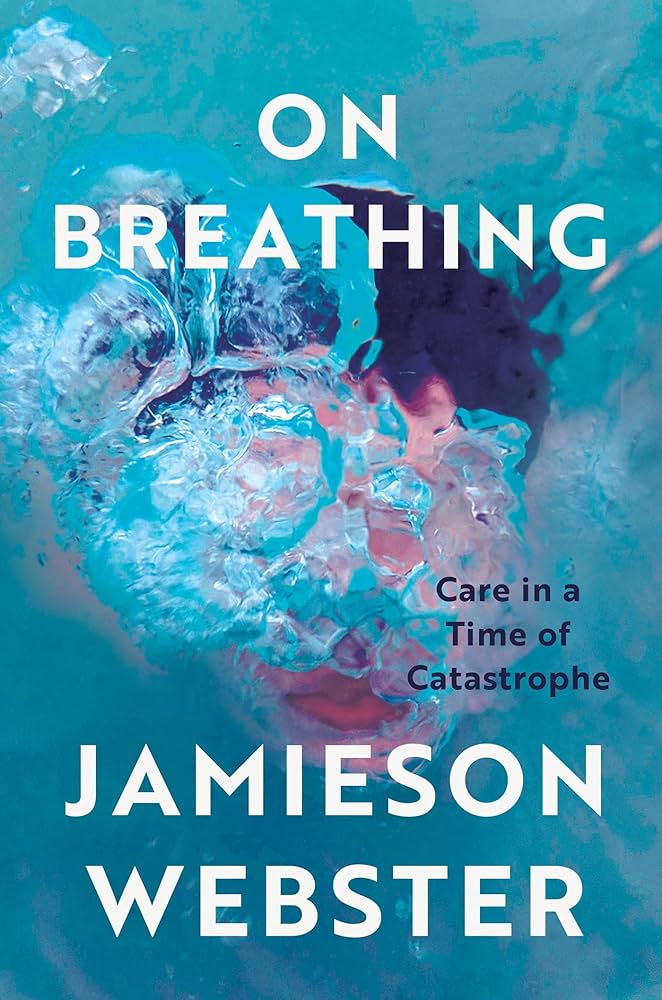
It’s a game that makes its player aware of the perils of taking respiration for granted. And I have been thinking of it not because it’s the sort of game that gets in my head and refuses to leave—though it is that—but because of a book that does something similar: On Breathing, by psychoanalyst and author Jamieson Webster, an extended essay in many brief parts that addresses a broad range of things that pertain to breathing. These include yoga, childbirth, childrearing, asthma, anxiety, the Kate Bush song “Cloudbusting,” swimming, and evolution, as well as the work of Freud, Lacan, Donald Winnicott, and other figureheads of psychoanalysis.
It is a wide-ranging text. Breathing, it comes as no surprise, seems to have something to do with nearly everything. Indeed:
From the moment of birth, breathing is something we must do for as long as we are alive, yet for the most part we don’t pay it much notice. If one of the main claims of psychoanalysis is that we forget sexuality, I think we must add breathing to our list of amnesias.
The book makes us mindful of breathing and many things that it touches, and it is appropriately wide-ranging. One part begins with a psychoanalyst friend telling Webster that she seems to be able to make other people dream. That revelation leads Webster to a discussion of the death of her father, and his life as a pilot, then to Luce Irigaray’s discussion of the difference between “western male philosophy” and “women’s philosophy,” the former of which is defined by its being exclusive and disconnected from all else, the latter of which “tends towards questions of relation, what takes place between the two.” The difference between them has to do with their relationships to breathing; and the consequences for forgetting out constant breaths are drastic. “The misogynistic hatred of women and of mother earth,” Webster writes, “is founded on an impossible mourning that is present in the forgetting of air. The terror of birth, losing our home within our mothers, leads to sexism and the forgetting of what we share. The elevation of the individual first triumphant breath is propaganda.”
Our breathing connects us to other breathing people—which is something we were all made keenly aware of in the recent pandemic. Webster writes about her time spent treating COVID patients, many of them terminal, in New York City at the height of the worldwide catastrophe. She describes the silence of the intensive care unit, where talking was forbidden:
Who was this rule for? The patients wouldn’t have been disturbed by the sounds of talking. Was it like holding your breath when you pass by a cemetery? The intensive care nurses—a special breed—seemed to float as they tended to the bodies, moving from bed to bed. It almost felt like we were already dead. Weirdly I found peace in the ICU. “To pray is to breathe,” says Kierkegaard. For the first time in my life, I prayed, not for myself but for these people, reduced to bodies, living by machines.
Webster writes elsewhere of the pandemic, “Never had we been forced to confront the stark opposition between the pursuit of individual freedom as America has so gloriously and so vainly defined it and the reality of the nine billion inhabitants living and breathing in a shared atmosphere.”
This is not a COVID book, exactly. The virus comes up often, but it is not the most important thing. And I don’t know that Webster draws any grand conclusions concerning that planetwide disaster. I’m not sure that is even possible, just five years after the trouble began. As it pertains to COVID, On Breathing comes across more as a means for processing what we have survived, the mass death that we have had to try to put behind us in the name of carrying on.
The book accomplishes that while taking on a vast subject matter and handling it in a way that is not comprehensive—how could it be?—but is satisfying all the same. Webster makes great use of her book’s structure; the brief parts that make up the whole long essay appear less like fragments than fully realized trains of thought. She picks something up and does not set it down again until it has been fully considered. On Breathing may even be regarded as not one long essay but a collection of brief essays, each one cohering as a complete consideration.
While Webster strays into any number of subjects, moving from one to another with the irresistible sinuosity of the essay genre at its best, she can be counted on to bring the conversation back to her field of expertise, to psychoanalysis and its theorists. That has the potential to be daunting. I have read a couple of Webster’s earlier books and have faced moments in them when I had to admit I did not know what she was talking about. My knowledge of the field and its vocabulary is limited, and things don’t have to get very esoteric before I feel left out and have to google words that are being used in ways I don’t quite understand. But there is little to no risk of that happening with On Breathing. Webster is careful to keep the reader at her side at all times. It is another aspect of the book that is abetted by the structure. The brevity of each part of the essay prevents the conversation from getting obscure.
There are other perils. Close attention to one’s own breathing is an aspect of practicing mindfulness—and while I have some positive associations with that word, I also associate it with the legion of grifters and charlatans who want us all to buy pill supplements and/or join their sex cults. I don’t know that these villains are so ubiquitous; I wonder if I am inflating their presence in the world in my imagination. But I gather that Webster has similar things on her mind when she asks, “How can I write about breathing without discussing Eastern spiritual practices, yoga, and wellbeing? I don’t really want to do it, perhaps because the way wellbeing practices parallel the expansion of psychoanalysis, especially in the United States, fascinates and revolts me.” Serious fields of study and inquiry share a narrow border with crankery, and Webster has to walk a tightrope as she ventures hesitatingly into the air above the latter, writing:
Twenty-first century mindfulness preaches that all we need to do is breathe, as if eight billion individuals breathing properly will make social problems evaporate. Is all breath work optimistic about what it achieves? How much should we worry about the cruelty of this optimism, especially as air itself becomes a privilege—an increasingly scarce commodity that is unequally distributed?
Webster writes about the power of breath control, and the claims that have been made in its favor:
When it comes to breath, the promises are infinite. Re-learning to breathe through your nose, the foundation for a whole range of breathing practices, promises a panacea that cures snoring, sleep apnea, chronic congestion, asthma, anxiety, emphysema, autoimmune disease, erectile dysfunction, misshapen faces, narrow jaws, and crooked teeth, while also making for athletic superiority and, finally, spiritual enlightenment… Occasionally, certain breathing techniques are said to cure schizophrenia.
Webster is always skeptical enough to not lose her footing, when discussing these things, which is a relief. There is no net under the tightrope she walks across, nor is there even a hard concrete floor for her to collide with. Rather, there is the risk that she could be misperceived as the next Marianne Williamson or—heaven forbid—Robert F. Kennedy, Jr.
I will admit that some of my worry on this front comes from my awareness of how others perceive psychoanalysis. Reading On Breathing, I heard once again the distant echoes of old friends from my grad school days, who could not believe I was reading Freud for a literature seminar. I had to try to tell them why his work was useful in that context, while they smirked at me with folded arms, for in their minds they had won the conversation already, as they knew that Freud had long since been “discredited.”
I should forget those people, but I can’t, and I can at least say that Webster never gives my old so-called friends much ammunition to use against her. When Webster explores the danger zones of what breathing can do for us, she does it with a healthy skepticism.
Since I started reading On Breathing, I have been self-conscious about this thing that my lungs do all day and all night. I have been thinking about breathing, my own and others’, more often than ever before in my life—which is remarkable, I think, since I have been doing it nonstop for forty-four years.
It’s why I started this by writing about Oxygen Not Included. I suppose that all digital people, in every video game, have to breathe electronic air. But I don’t know of another game in which that gets acknowledged, in which it matters and has consequences, and I never considered it significant before. If nothing else, like this game that I play, On Breathing assures us that breathing has consequences, that it matters, that this thing we have all been doing nonstop since the moment we were born is an important reminder of the biology we have in common, and of how vulnerable we are to its disruption.
On Breathing is available through Catapult. Purchase it now through their website.
Like what you’re reading?
Get new stories or poetry sent to your inbox. Drop your email below to start >>>
NEW book release
NEW book release AWRY by duncan b. barlow. Order the book of stories of which Brian Evenson calls “meticulous and precise, painful and surprising.”
GET THE BOOK