Drama. 148 pgs. Culicidae Press. April 2025. 9781683151203.
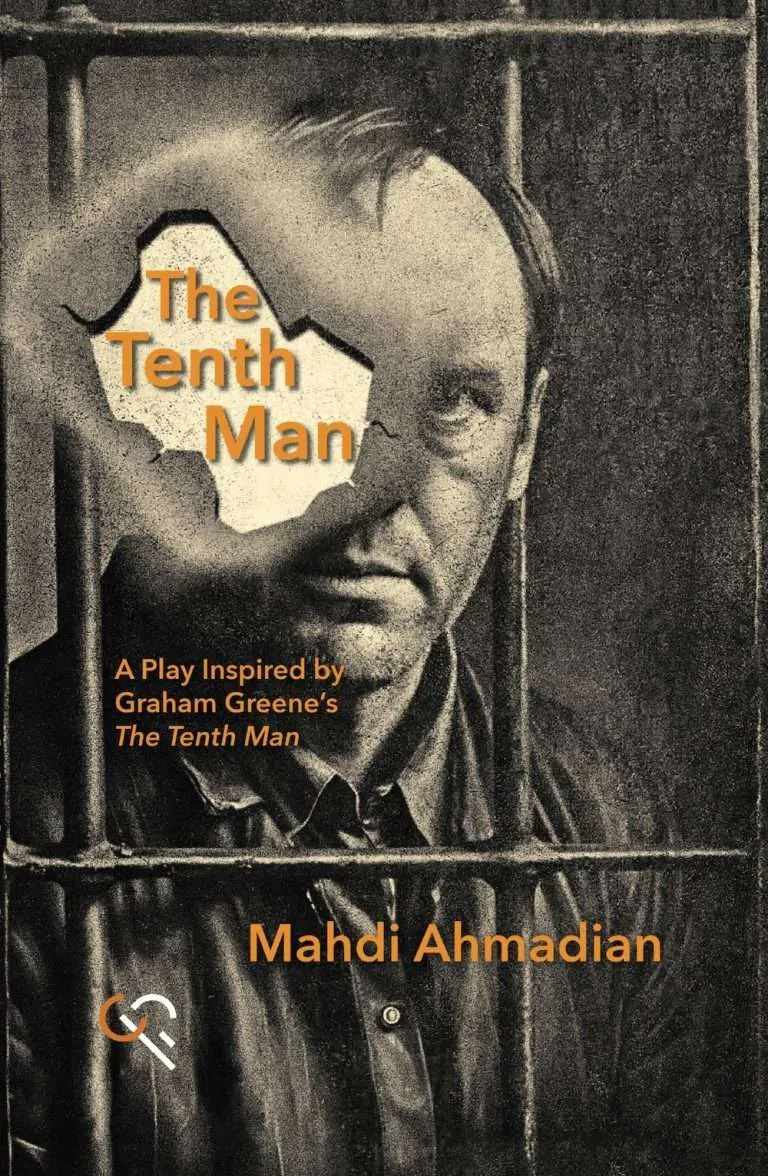 The Tenth Man stands as a powerful testament to Mahdi Ahmadian’s command of dramatic form, language, and theatrical technique. Among his body of work, this play is one of the most harrowing and formally daring. It is an experimental piece that employs an intentionally minimal set in key scenes, evoking an atmosphere of stark psychological tension. The play merits critical recognition, not only as one of Ahmadian’s finest achievements but as a culturally and aesthetically important work by a gifted young playwright.
Ahmadian demonstrates remarkable mastery in storytelling, visual composition, character development, and structural precision. The dramatic architecture and idiosyncratic language of the play are tightly bound to his exploration of existential dilemmas: life, death, the fragility of meaning, and the breakdown of communication. One of the most distinctive features of The Tenth Man is its fluid movement between waking reality and dream states, between surrealism and magic realism. Though steeped in moral seriousness, the play occasionally veers into black comedy, achieving a tone that is at once haunting and absurd.
Rich in mystery, strange twists, and investigative complexity, The Tenth Man unfolds like a literary puzzle. Its logical structure and existential themes invite comparisons to the Theatre of the Absurd. In its bleak meditation on the absurdity of life and the collapse of interpersonal understanding, it recalls the work of Beckett and Ionesco. And yet, Ahmadian’s voice remains distinct.
In the play’s introduction, Ahmadian acknowledges his inspiration: Graham Greene’s novella The Tenth Man. Like Greene’s story, Ahmadian’s work reads in part like a thriller, ingenuous, inventive, and gripping.
Greene’s story is set in a Nazi prison in occupied France during the Second World War. A decree demands that one in ten prisoners be executed; lots are drawn to determine who will die. One selected man, a wealthy lawyer, offers all his possessions to anyone willing to take his place. A man accepts. After the war, the lawyer must confront the moral weight of this transaction.
Ahmadian sets his adaptation in wartime Paris under Nazi occupation. While the Vichy regime nominally governed France, real power in the occupied zone lay with the Nazi military administration, a dictatorship that allowed little pretense of French sovereignty. In this context, Ahmadian explores complicity, cowardice, resistance, and the psychological toll of occupation.
From the outset, Ahmadian’s creative staging reveals his artistic range. In Scene One, the interior of the café Monsignor Quixote is drawn in chalk on the stage floor, an evocative nod to Lars von Trier’s Dogville. In Scene Two, a schematic outline of a prison cell appears. This visual austerity enhances the play’s metaphysical tension. Characters also shift roles throughout, a technique borrowed from the tradition of Jean Genet’s The Maids, where identity becomes fluid and performative. Such transformations recall literary devices from the picaresque novel, in which costume changes signify the instability of persona. The technique finds roots as far back as The Thousand and One Nights, Samak-e Ayyar, and Khosrow and Shirin by Nezami. In fact, Hafez alludes to this theatricality in his poetry, naming it “cloak-turning” (قباگردانی). He writes:
یغمای عقل و دین را بیرون خرام سرمست / بر سر کلاه بشکن در بر قبا بگردان
(“Drunken, go forth to plunder reason and faith; Tilt your cap askew, and change your cloak.”)
Scene Three depicts the architectural sketch of a country house and three execution poles. Once again, characters undergo role reversals. The porous boundaries between dream and reality are reinforced through physical actions, characters handle imaginary objects, wipe imaginary mirrors, or wash hands with imaginary water. These moments echo the physical comedy of Buster Keaton, but are rendered here with a darker, psychological undertone.
Set firmly in the historical moment of occupied Paris, the play draws attention to the atrocities of war, particularly the moral corruption and loss of human dignity under totalitarian regimes. The Geneva Conventions speak of humaneness and honor in the treatment of prisoners. However, thinkers like Einstein and Aldous Huxley saw the role of the soldier as fundamentally dehumanizing. Einstein once said, “He who marches does not need a brain,” while Huxley observed, “Soldiers of all the nations march towards a common grave.” In Le Silence de la Mer, Vercors cites Anatole France: “Il est beau qu’un soldat désobéisse à des ordres criminels.” (“It is a fine thing when a soldier disobeys criminal orders.”)
War degrades moral responsibility. As history shows, from the Nazi concentration camps to the tortures at Abu Ghraib, violence in war is rarely contained by necessity or legality. Viktor Frankl, in Man’s Search for Meaning, offers a deeply personal account of survival in concentration camps, emphasizing the spiritual struggle to preserve human dignity. Within such a framework, The Tenth Man must be read not simply as political drama but as existential allegory.
In the play’s opening scene, after the minimalist sketch of the café, posters of Nazi propaganda fill the space. These images serve as visual testimony to the enemy’s psychological domination, its intent to suppress resistance and silence French identity. In contrast, characters in the café reflect varying moral alignments. Anna, fearless, proclaims: “I am not afraid of death.” By contrast, Fowler, described by Maurice as “genetically corrupt”, is a spy, a Nazi collaborator. Maurice blames Fowler’s nature on inherited brutality: his father was a hunter of birds, and Fowler has simply shifted that violence onto human prey.
Fowler’s line, “Resistance is dying slowly,” reveals his stance. When German officers arrive and accuse the café of harboring resistance activity, Fowler’s betrayal is made explicit. Colonel Lehr and his men, cold and authoritarian, announce: “We have reports of resistance activity in this café.” They execute Maurice on the spot and beat Chavel savagely. Other patrons are rounded up and thrown into prison.
As Ahmadian writes in his introduction, fate plays a central role in his adaptation. He retains Greene’s concept of drawing lots to decide who will live and who will die. This act, though brutal, is steeped in historical and cultural resonance. In ancient Greece, drawing lots was a means of ensuring fairness and avoiding bias. In the Christian Bible, the crowd draws lots and releases Barabbas, sending Jesus to his crucifixion. Shirley Jackson’s short story “The Lottery” offers a modern American iteration of this primal ritual, where a town selects and stones one of its own to ensure a good harvest.
Ahmadian harnesses this theme to chilling effect. In the play, Colonel Lehr tells the prisoners: “Three of you must be executed at seven tomorrow morning. Which three is up to you. Cast lots if you wish.” This cruel abdication of responsibility is psychological torture disguised as bureaucratic fairness. When Chavel draws the marked slip, panic overtakes him. He pleads. Then Janvier, another prisoner, offers to take Chavel’s place, for a price. He demands Chavel’s wealth and inheritance in exchange for his life.
This pivotal scene, where Chavel, facing death, offers to sell his life for wealth, marks a turning point. Though Ahmadian draws from Greene’s narrative architecture, he expands the scope of the play into a deeper metaphysical realm. The plot grows increasingly layered, surreal, and theatrical. Characters shift names, adopt new identities, and roles are swapped in unexpected ways. The dead return. The man who died, Janvier, later Michel, reappears, blurring the boundaries between memory, guilt, haunting, and resurrection.
This reinvention of identity and the return of the dead is reminiscent of Bahram Bayzaei’s film Mosaferan (The Passengers). In Bayzaei’s haunting story, a family perishes in a car crash en route to a wedding ceremony, yet later reappears during the mourning ritual. Their return is spiritual rather than physical, imbued with symbolism. The play of light in the mirror the bride receives, an inherited object, becomes a conduit for memory, transformation, and unresolved grief. Ahmadian’s use of reanimation performs a similar function: it collapses the finality of death into the elasticity of myth and narrative.
This conceptual turn elevates The Tenth Man from a historically grounded thriller to a meditation on identity, morality, and the psychological aftermath of war. The character of Chavel, burdened with guilt, becomes a vessel for existential crisis. After purchasing his survival through the death of another, he assumes a new identity and returns to the home of the deceased, an act that echoes classical tragedy. In Greek drama, the return of the disguised or transformed hero often serves as a vehicle for catharsis and self-confrontation. In Ahmadian’s play, the same device is used to reveal inner torment, suppressed guilt, and the desire, perhaps futile, for redemption.
Chavel’s psychological evolution is not linear. He does not emerge purified but fractured. The house he returns to, once Janvier’s, becomes a stage for hallucination, reenactment, and confession. Ahmadian skillfully destabilizes time and space here. Conversations repeat, roles reverse, and characters behave like specters, moving through scenes that are both theatrical and ghostly. The very architecture of the home begins to feel like a psychological labyrinth, a mirror of Chavel’s inner turmoil.
Another important dynamic emerges between Chavel and the woman, Janvier’s sister. Her presence challenges Chavel’s attempt at concealment. In many ways, she functions like the Furies of classical mythology: an embodiment of moral reckoning. Whether or not she knows Chavel’s true identity becomes less important than what she symbolizes. Through her, the house becomes a trial, and Chavel’s continued impersonation grows increasingly untenable.
Ahmadian further emphasizes this moral disorientation through recurring symbolic gestures: cleaning imaginary mirrors, setting ghostly tables, reenacting memories as if they were present realities. These repetitions evoke the performative nature of memory itself, the way trauma rewrites the present. The priest, who earlier washed his hands with imaginary water, becomes a figure of hollow ritual and lost authority. Like so many others in the play, he goes through motions that signify a faith no longer grounded in certainty.
What keeps this second half from descending into abstraction is Ahmadian’s control of dramatic rhythm. He oscillates between the metaphysical and the mundane, the dreamlike and the brutal. Small gestures, pouring imaginary tea, changing names, denying recognition, are charged with emotional weight. This duality gives the play its unique tone: at once cerebral and visceral.
There are also moments of dark humor, slyly inserted to disorient the audience. In these moments, the play takes on the features of black comedy, revealing the absurdities that persist even in spaces of grief and guilt. A soldier makes an ill-timed joke; a character rehearses a speech as if life were a stage. These Brechtian interruptions serve to remind the viewer of the artifice of theater, while simultaneously forcing reflection on the moral failures of real life.
As the narrative spirals toward its conclusion, the play returns to its central theme: justice, not as law, but as existential judgment. Who deserves to live? Who decides? Can atonement be earned, or is it merely performed? In Greene’s novella, the lawyer ultimately reveals himself and offers restitution. In Ahmadian’s version, the path is murkier, more morally ambiguous.
In the climactic scenes, Ahmadian incorporates a blend of visual minimalism and emotional intensity. The execution of Chavel, whether literal or symbolic, is not shown in graphic detail but rendered through abstraction, sound cues, lighting changes, silence. The audience is left in a space of uncertainty, a deliberate withholding that mirrors the ethical gray zone the play occupies.
This ambiguity is not a weakness but a deliberate strategy. In refusing easy answers, Ahmadian insists on moral complexity. The final tableau does not offer closure, only echoes: footsteps, murmured prayers, unfinished confessions. The dead linger. The living are not absolved.
What distinguishes The Tenth Man from typical historical dramas is its refusal to adhere to realism. While grounded in a specific era, the Nazi occupation of France, it transcends its setting to become a philosophical meditation on fear, guilt, complicity, and the human capacity for both cowardice and courage. The play draws from a rich tapestry of literary, religious, and theatrical sources, Greek tragedy, Islamic mysticism, Brecht, Beckett, and the modern Iranian stage, without ever becoming derivative. Ahmadian synthesizes these influences into a voice that is unmistakably his own.
In its final moments, The Tenth Man leaves the audience not with answers but with questions. About the cost of survival. About the limits of forgiveness. About how long the dead may haunt the living, and whether such hauntings are deserved. It is a play that refuses to flatter its audience, confronting them instead with their own moral thresholds.
Ahmadian has created a powerful, haunting work that resonates far beyond its historical frame. The Tenth Man is not only a major achievement in contemporary drama but a necessary work of art in a time when questions of complicity, silence, and responsibility remain painfully relevant. It is an exceptional theatrical experience, bold, unsettling, and unforgettable.
The Tenth Man is available through Cuilcidae Press. Purchase it now through their website.
Like what you’re reading?
Get new stories or poetry sent to your inbox. Drop your email below to start >>>
NEW book release
NEW book release AWRY by duncan b. barlow. Order the book of stories of which Brian Evenson calls “meticulous and precise, painful and surprising.”
GET THE BOOK