Fiction. 272 pgs. Bloomsbury Publishing. January 2023. 9781635579789.
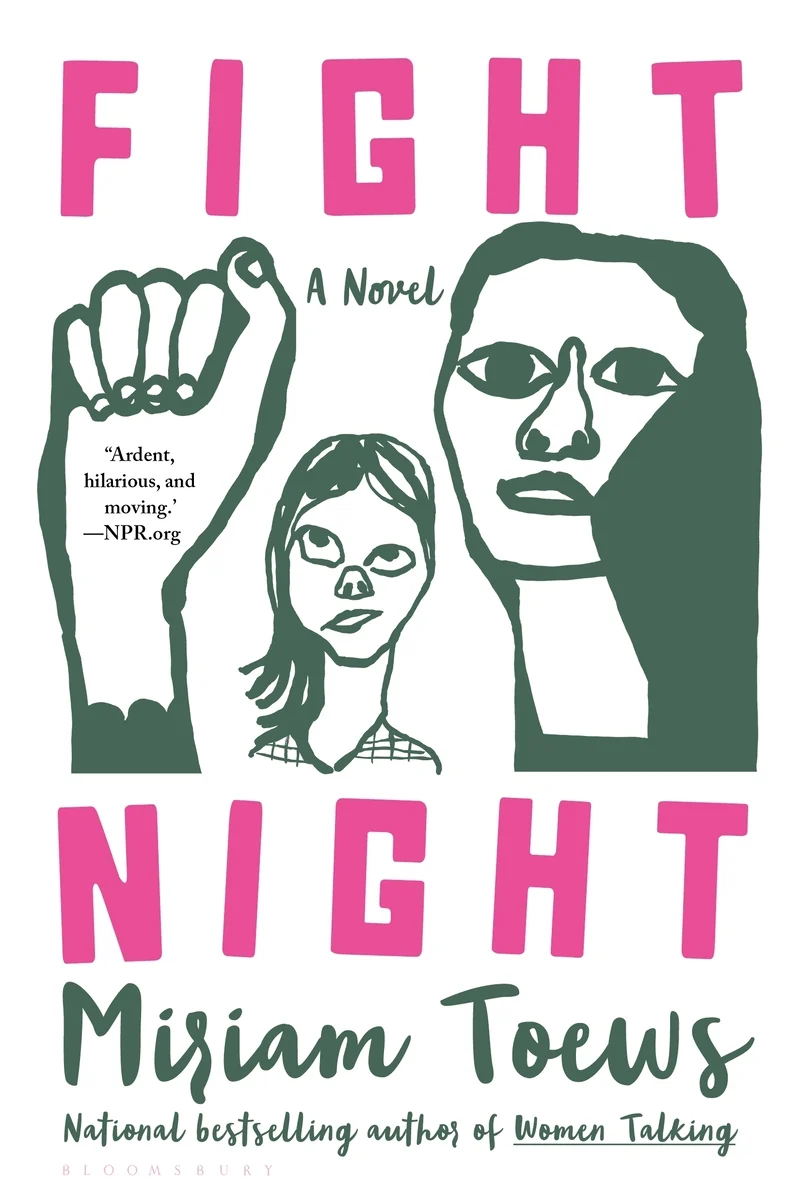 Fight Night by Miriam Toews is a short book that packs a punch. We hear it straight from eight-year-old Swiv, who is stuck at home after being suspended for fighting in school. In a voice that is equal parts brash and innocent, Swiv writes to her absent father about life with her anxious, overwhelmed mother and her irrepressibly silly grandmother. In their chaotic household, Swiv learns that fighting doesn’t only happen with fists—it happens every day you show up to face illness, grief, and injustice with grit, laughter, and love. As Grandma puts it, “to be alive means full body contact with the absurd.” In our current cultural moment, shaped by intergenerational trauma, burnout, and the politics of care, Fight Night is a revitalizing force. It’s a story that reframes caregiving as resistance—and joy, especially among women, as a radical act.
Toews’s prose moves at a frenetic pace, with delightful turns and endless pockets of humor. Swiv’s youthful voice delivers an incredible amount of emotional insight with conciseness. She’s observant, but Grandma and Mom also don’t hold much back from her, whether it’s an update about their bowel movements or the story of how Grandma gave Mom a gift basket when she lost her virginity at sixteen. She delivers pitch-perfect renderings of the dialogue that shapes her world. It’s both hilarious and heartbreaking—but what might seem inappropriate is rendered instead as raw, unfiltered intimacy. Through these moments, Toews paints a vivid portrait of three women who are messy, complicated, and deeply alive.
While Swiv is our narrator and witness, Grandma Elvira is the novel’s beating heart. She is exuberant, eccentric, and emotionally fearless. As Swiv observes, “Grandma likes speed and laughing. She likes stories to be fast and troublesome and funny, and life too. She doesn’t like hauling epic things around, which is why she saws up her books.” She contemplates death and jokes about knowing Marcus Aurelius (“Grandma’s friend that understood impermanence”). Swiv speculates, “At some point in Grandma’s life, someone must have threatened to kill her whole family unless she became friends with every single person she met.” Elvira is not a woman to be sidelined—she lives loudly, and she has life left to live yet.
Despite its playful tone, Fight Night doesn’t shy away from the heaviness of survival. Grandma is fighting what she calls her “Triple Scoop Sundae”: gout, trigeminal neuralgia, and angina, “with a topping of arthritis.” Mom is suicidal, underemployed as an actress, and on her “third try, mister!” of pregnancy. Meanwhile, Swiv—housebound from school—spends her days studying subjects like “Poached egg,” dream analysis, and Latin medical terms, while also bathing Grandma, doing the laundry, and caring for her mother. She is a child and caregiver rolled into one.
This intergenerational dynamic has been a key form of storytelling in contemporary literature and media. Like Hai and Grazina from Ocean Vuong’s The Emperor of Gladness, Toews places the old and the young—those often pushed to the margins—at the center of the story. The generational divide between the three women is evident: Grandma, who survived the grief and losses of war, sees joy as subversive. Mom, whose wounds are more recent—divorce, career instability, and emotional abuse—responds with cynicism and rage. In a microcosm of their lives, Grandma shouts “Bombs away!” as she scatters conchigliettes and her medication all over the ground. Mom reacts with exasperation. Swiv picks up the pieces on the ground.
Scenes like this highlight how Grandma Elvira refuses to be diminished by age or circumstance. She is part of a growing lineage of older female protagonists—like Evelyn Quan Wang in Everything Everywhere All At Once, Deborah Vance in Hacks, and Janina Duszejko in Drive Your Plow Over the Bones of the Dead—who resist cultural narratives of invisibility and decline. How often do we see older women at the center of the action? How often are they full of humor, agency, and contradiction? In Elvira, we get a fully human character who refuses invisibility. Her aging is not a tragic decline but a call to action.
Meanwhile, Swiv’s mother represents the exhausting emotional labor of caregiving. She and Grandma clash in their philosophies: Grandma lets go, forgives, and laughs. Mom clings onto her pain to survive. At times, Swiv seems like the most emotionally grounded of the three. Trauma trickles down, but each generation “fights” in their own way.
Elvira’s relationship with Swiv is where the novel finds its deepest emotional charge. She raises Swiv not with fear, but with tenderness, humor, and the tools for survival. She teaches her how to cook, clean, and face the world with courage—like a general preparing her soldier for life. She tells Swiv, “Fighting can be making peace” and “You’ll know for yourself what to fight.” Resilience is her legacy. Through her stories, she passes on the burden of memory in a way that doesn’t crush Swiv, but equips her—transforming pain into care.
Through these layered characters, Toews crafts a nuanced portrait of women’s strength. Their daily acts of care—often invisible, often uncelebrated—are the true fight. Fight Night offers an intimate look at a non-traditional family: three women, at different stages of life, who argue, forgive, and support each other in imperfect but powerful ways. They prove that a family doesn’t have to be traditional, or even tidy, to be good.
Crucially, much of the novel’s drama—Grandma’s life-saving surgery, Mom’s international movie role, Dad’s disappearance—takes place in the past. Rather than centering these traditional dramatic beats, the focus of Fight Night remains on the daily, emotional battles its characters face to simply live, love, and stay sane. Toews reminds us that not all acts of heroism are loud or cinematic. Every act of care is a small revolution, and to survive is not one night of combat—it’s a lifetime.
This emotional clarity comes from Toews’ own lived experience. She draws from her own family history and Mennonite background, shaped by displacement and persecution. Like her characters, Toews has lived through loss—her mother’s name is Elvira, and she too lost a sister and father to suicide. Her forthcoming memoir, A Truce That Is Not Peace (out August 26, 2025), promises to further explore the themes of survival and storytelling in her own life.
As someone who grew up in Southern Ontario and spent my college years in and around Toronto, I felt at home in this novel. I know the sausage from Kitchener is the best. I’ve been to nail salons in Scarborough, picked up prescriptions at Shoppers Drug Mart, and—like Swiv’s relatives in Fresno—I moved to California when I didn’t want to freeze anymore. These details made the setting of the story truly come alive.
I recognized the landmarks in the novel—but more importantly, I recognized the emotional terrain. What I learned from this book is simple and profound: care is activism, laughter is survival, and there are many different ways we can fight. Even the smallest daily acts can be revolutionary because that’s the kind of fight that saves lives. That, and the truth at the heart of Grandma’s wisdom: “There are no winners and losers when it comes to bladder control.”
Fight Night is available through Bloomsbury Publishing. Purchase it now through your local bookstore.
Like what you’re reading?
Get new stories or poetry sent to your inbox. Drop your email below to start >>>
NEW book release
NEW book release AWRY by duncan b. barlow. Order the book of stories of which Brian Evenson calls “meticulous and precise, painful and surprising.”
GET THE BOOK