Fiction. 320 pgs. Quirk Books. January 2025. 9781683693956.
 January of 2025: a particularly poignant time to publish anything political. So much so that it was hard to encounter a piece of writing that wasn’t directly participating in a larger national conversation—and this didn’t only true for books. A good portion of notable media this year has been, if not outright political, then clearly issue-driven.
In a March 2025 New Yorker article, “The New Literalism Plaguing Today’s Biggest Movies,” academic and novelist Namwali Surpell describes this film style, New Literalism, which rarely, if ever, depends on symbolism as a primary messaging tool. As Surpell explains, though, that doesn’t necessarily translate to having a basis in realism:
“When I say [new] literalism, I don’t mean realistic or plainly literal. I mean literalist, as when we say something is on the nose or heavy-handed, that it hammers away at us or beats a dead horse.”
She was referring to the 2025 set of Oscar nominees, many works of which fall into New Literalism: art created to make an impossible-to-miss point. There’s little room for nuance. While films such as The Substance and Anora are undoubtedly gorgeous, with aching cinematography and visceral body imagery, there’s also no doubt that the audience knows exactly what they’re supposed to take away, and chances are they know it going in.
This trend is undeniable, but it begs a bigger question: in times of global turmoil, is nuance the imperative of art? Or does the artist have a larger responsibility to use their platform for a more pointed purpose?
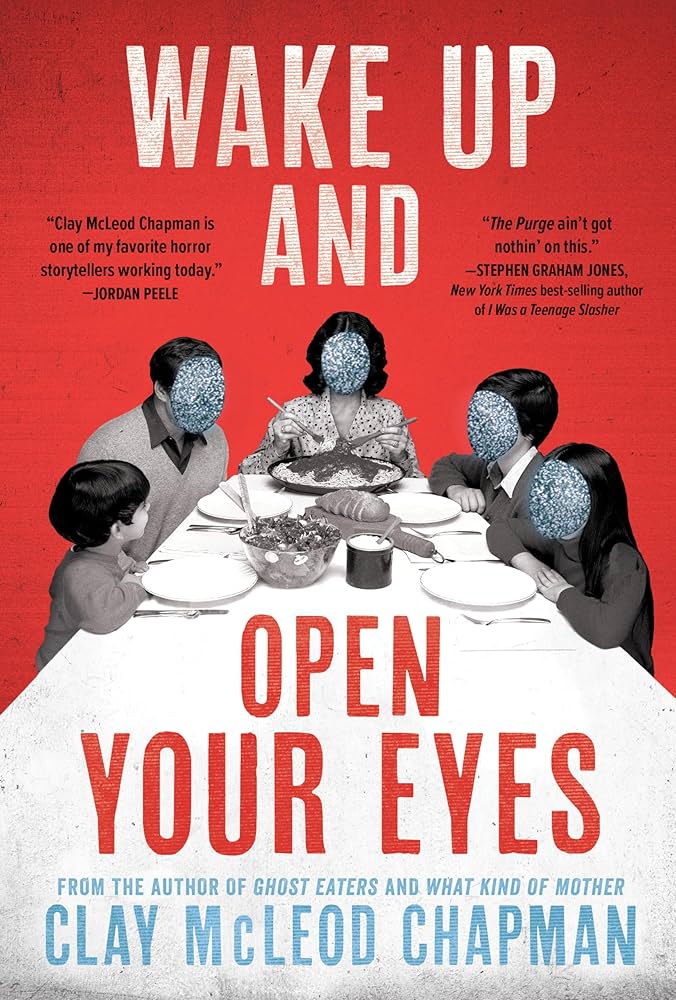
This is a question of philosophy and principles and possibly even religious doctrine—that is, it’s all subjective—but it comes to mind when reading Clay McLeod Chapman’s Wake Up and Open Your Eyes, published January 7, 2025, by Quirk Books.
Following Noah, a 30-some liberal who’s married to a Black woman and father to a biracial child—and this is predominantly how he defines himself—the narrative is contained within just a week. After a few days of his calls and texts going unanswered, Noah drives from New York to Virginia to check on his parents. When he arrives, he discovers that they’ve slipped beyond recognition, spiraling from their racist-leaning tendencies into what Chapman coins “mad cow disease for conservatives”:
“Fax News Brain. It’s spreading. It’s communicable.” (pg 268)
Chapman dives about as far into literalism as possible here. Viewers with Fax News brain are, essentially, hate- and fear-fueled zombies, devotees to their screens and the misinformation held within. When Noah tries to turn his parents’ multiple TVs off, they turn violent, attempting to kill him. Noah responds in kind. After they’re dead, while suspended in an anesthetized state, he turns the TV back on, to CNN this time, and discovers that this exact domestic drama is playing out in households across the nation: brainwashed Fax News viewers are trying to kill anyone who comes between them and their ideology. And then the chaos spreads, turns even more mindless, begets even more chaos. These zombies exist in their most base forms, fornicating with and eating one another with equal zeal, tearing bystanders apart instinctually.
All in all, it is not a narrative of nuance.
The story is broken into three “phases”: “Sleeper Cells,” as described above, then “Recruits,” then “Holy War.” While the first and third sections of the story are guilty of hitting a bit too close to the morality nose—as may be inferred by their titles—“Recruits” removes the reader from the immediate violence of Noah’s interaction with his parents and all of its ensuing literalism. This center section reads, figuratively, as an emotional guidebook into conspiracy-land. Literally, it reads as the six-step process of demonic possession.
Also not exactly subtle.
It’s here, though, that the reader finds a surprising balm: empathy. Undoubtedly, the book casts an unflinching eye—often going so far as to make the reader flinch, instead—on disinformation, rage politics, and hate rhetoric. It’s a book that makes a very clear point, yes. But then it goes further, not only casting judgement on the what, but casting curiosity into the why. In fact, the center section barely focuses on politics at all. It mainly focuses on loneliness.
Casting Noah and his parents aside for a moment, this section jumps to Noah’s brother, sister-in-law, and nephews. Also based in Virginia, they’re a cookie-cutter, socially-liberal-but-fiscally-conservative family: there’s hardworking dad, Asher, then underappreciated mom, Devon, then bullied teen Caleb, and finally adored-but-somewhat-neglected kid son Malcolm.
This family leans more caricature than character. Chapman gives the reader broad strokes, tempting them to fill Asher, Devon, Caleb, and Malcolm in, and so the reader does. This serves a craft purpose. It also serves a psychological one.
On a craft level, the reader adapts these characters to whoever in their life undoubtedly fills the role of that same caricature, which makes it easier to empathize with them, to have sympathy for them. It makes it easier for the reader to see themselves as Asher or Devon or Caleb or Malcolm or all of them all at once. Each of their individual arcs contains at least one unbearably relatable moment. After all, who hasn’t felt at least a little bit as angry as Asher?
One day’s anger became the soil for the next day’s petty resentments, and the next, choking out his arteries…. He’d come home grumpy and go to bed grumpy and wake up grumpier.
Asher needed an outlet for his anger.
Fax felt like a good fit….
It was all the other hours of the day, when he wasn’t watching Fax, that his frustration had nowhere to go. At least here he knew what to be angry about, because Paul Tammany told him so. (126–127)
Or as lonely as Devon?
Devon was ready. She needed this. This connection. She curled up with her tablet and ran her index finger across the screen, grazing YOGAMAMA’s tanned skin…
All these sirens offered private glimpses into their homes, snapshots into the lives of women just like her, mothers just like her. The same struggles. The same endless search for soul sustenance. The same uphill battles with their health.
But Devon liked Larissa’s—sorry, YOGAMAMA’s—life best. She spoke to her the most.
Aren’t you just tired of . . . being tired?
Yes, as a matter of fact, she was. (112–113)
Or as insignificant as Caleb?
Caleb existed within two separate worlds: There was the world his family inhabited, the world of school. His nonexistent friends. The Chads and Beckys. The breeders.
Then there was E.
He and Elzegan had carved out a world just for the two of them. Caleb yearned for his virtual existence more and more. The longer he was away, the more he pined to slip back in. (170–171)
The basis of empathy is a shared emotional connection, and that’s what Chapman is creating between the reader and these characters. From a psychological perspective, though, the caricaturization of this family also puts the reader in the position of casting judgement—we see them pretty purely as stereotypes even while we’re personalizing them. It’s a conflicting experience, one that reminds us that we’re not quite as innocent as we’d like to think. Which in turn reminds us that preying on anger, loneliness, and shame—three of the most difficult emotions for any human to reckon with—is a cornerstone of both fearmongering and rage politics. Which in turn makes us ask: Am I susceptible to this, too?
And then Chapman demonstrates how simple it is to go from being lost to being found: the reader witnesses how these so-called saviors, the Paul Tammanys and social media sirens and shady online Es, find those who’ve become isolated. How they have systems in place to both drive said isolation and act as its safety net. Very few, if any, of the incredibly destructive choices Asher, Devon, and Caleb make (Malcolm, as a child, is too innocent to be susceptible to Fax’s brainwashing just yet) are made on the basis of other people at all—the deciding factor always came down to whatever would make them feel like they belonged. Like they were important to someone other than themselves.
It was that someone who convinced them that violence was the answer, and it was their lack of real-world support that allowed the violence to root into them. What Chapman demonstrates so beautifully here: without a sounding board, anything can be shouted out as sane. He’s doing what horror does best, putting the reader in the perspective of the monster. Forcing us to experience their villain origin story, to go through the same hateful transformation. Isolating us. Wounding us. Offering us solace. Chapman isn’t exactly insisting that the reader sympathize with this family, but he is insisting that the reader see them.
In the case of Wake Up and Open Your Eyes—in the case of so much real-world villainy—said monsters are your neighbors, coworkers, or in-laws, and this cycles back to that impossible question of whether or not nuance is the imperative of art. Chapman’s opinion is clear: Fax News’s agenda prioritizes destruction, and society’s reliance on media is what maximizes that destruction. But Chapman also clearly puts the reader in a murky position when he demonstrates how easily solace can come in the form of servitude. He makes us realize the classic uncomfortable truth of horror: labeling someone as a monster is a self-fulfilling prophecy.
That’s part of what makes satire so difficult to write in this day and age.
Satire and literalism aren’t opposites, exactly, but they have opposing methods: whereas literalism leaves no room for interpretation, satire is almost daring the reader to interpret literally. For this reason, it’s often considered a high-brow literary art form, which also isn’t exactly true; for it to be effective, though, its audience does need a shared level of education—or, at the very least, a shared reality.
If, instead, “you live in a political environment where there’s no majority on basic facts,” as Sarah Rahman writes in the Book Riot article “Why is Satire Challenging for Modern Readers to Understand?,” then “understanding satire is quite a distant dream.”
Justin E.H. Smith echoes this sentiment in the New York Times’s “The End of Satire,” saying that “it has become impossible to separate [satire] cleanly from the toxic disinformation that defines our era.”
To put it bluntly: the age of disinformation has spiraled to the point where satire often feels less potent than the daily news, and this takes some of the bite out of the genre. Exaggeration is no longer a very effective tool when the absurd become commonplace, so how do writers achieve the same psychopolitical effect?
Chapman does this not by escalating but by de-escalating. He doesn’t need to add any drama to the phenomena that fiction is less frightening than groupthink, so instead, he plays down said phenomenon by employing an impressive literary technique: a form of emotional remove that allows Chapman to describe horrific moments without falling into melodrama, a common bane of horror writers.
In the third section of the narrative, after the reader has witnessed firsthand the violence of Fax News brain and the myriad ways American citizens fall captive to it, Noah and his youngest nephew Malcolm attempt to make it from Virginia back to New York in what is, essentially, a zombie apocalypse. This “Holy War” is pure horror: stomach-churning encounters told in gristly detail. The whole world has come undone—no, is actively undoing itself. How do you relay that kind of madness without hollowing it out?
By flattening the emotion, by presenting it to the main character instead of the main character presenting it to the reader. We don’t see this section through Noah’s eyes; it’s narrated to us in second person by a figment of Noah’s traumatized mind, a psychosis of CNN:
Your brain needs to break. Let’s let your mental faculties take a breather. How about we hand over the controls to professionals, okay? Who can pilot us through the apocalypse?
Anderson Motherucking Cooper, that’s who. (261)
Chapman plays a lot with perspective in this story, and the reader is typically aware when they’re getting a tailored take on what’s going on. The third segment, the “Holy War,” feels reminiscent of an episode of 60 Minutes, a clinically detached investment in the state of the world—which in itself is an absurd divergence from the title of the section. Everything should matter so much more than it does, but Noah simply doesn’t have the capacity to make it matter. He’s beyond his limit; his brain has dissociated. Take this ridiculous, Tarantino-esque moment just after he’s had to brutally murder his sister-in-law, Devon, when he and Malcolm are first trying to get out of the neighborhood through a slew of zombified neighbors:
Kids are climbing all over the car now. You can’t help but curse Devon for not topping off. You’re intimately familiar with the rubber skid of tennis shoes. They scuffle and slip all around.
You put the car in drive and aaawaaaaaaay we go . . .
The muffled sound of tiny bodies tumbling off the roof and into the streets fills your ears.
It’s very upsetting. (303)
The emotional numbing here not only reflects Noah: it reflects the state of the country as a whole. How many American citizens feel utterly hopeless in the face of what feels like a mindless mob, no matter where you stand on the political spectrum? How many news channels feel like a parody of themselves, no matter which pundits they present?
The irony here is that said numbing is, in itself, a form of emotional connection, a type of empathy. Wake Up and Open Your Eyes takes political divisiveness to its cannibalistic brink, and at the same time, it reveals how this fissure began in the most shared human experience: loneliness. It shows the unity of our exhaustion. It doesn’t offer any sort of promise—and in fact ends on a note of horrific caution, not one of optimism—but it does give us pause. A moment to take a new breath. Which, ultimately, is how you start a conversation.
Wake Up and Open Your Eyes is available through Quirk Books. Purchase it now through their website.
Like what you’re reading?
Get new stories or poetry sent to your inbox. Drop your email below to start >>>
NEW book release
NEW book release AWRY by duncan b. barlow. Order the book of stories of which Brian Evenson calls “meticulous and precise, painful and surprising.”
GET THE BOOK